The Lives of Others came out in 2006, made on a budget of around two million dollars, and ended up grossing over seventy-seven million worldwide before walking away with the Oscar for Best Foreign Language Film. It was the first serious drama about life in the German Democratic Republic after years of the subject being handled mostly through comedy, and Germany received it that way, as something overdue. Director Florian Henckel von Donnersmarck was twenty-nine and making his first feature. The lead actor, Ulrich Mühe, had his own Stasi file waiting for him when the archives opened after reunification.
The film is set in East Berlin in 1984, five years before the Wall came down, and follows a Stasi officer named Gerd Wiesler who is assigned to surveil a playwright and his actress partner. What makes it worth watching has nothing to do with the surveillance itself. It’s about what happens to a man who spends enough time listening to other people’s lives that he begins to feel the weight of his own. The mechanics of the Stasi are just the frame. The actual story is about what gets through.
Wiesler and the Stasi System
It’s 1984, inside a prison in East Germany. We’re introduced to a special agent named Gerd Wiesler (Ulrich Muhe), cold and methodical, working through an interrogation like a machine purpose-built to extract the truth. Afterward, he teaches at an academy for young recruits, showing them how to read fear, pauses in breathing, and shifts in tone as signs of deception. For Wiesler, life isn’t about feeling, it’s about detection. He believes in the system completely. That system is the Stasi, East Germany’s secret police.
At its height, the Stasi employed around 100,000 officers and ran roughly 200,000 civilian informants, meaning roughly one in every fifty East Germans had some role in spying on their neighbors, friends, or family. To keep tabs on so many people, the Stasi also kept files on an estimated six million East German citizens, more than a third of the entire population. After his class, the head of intelligence Anton Grubitz (Ulrich Tukur) finds him and invites him to the theater that evening. Once they arrive, the chief tells Wiesler he has a new assignment: surveil a man named Georg Dreyman (Sebastian Koch).
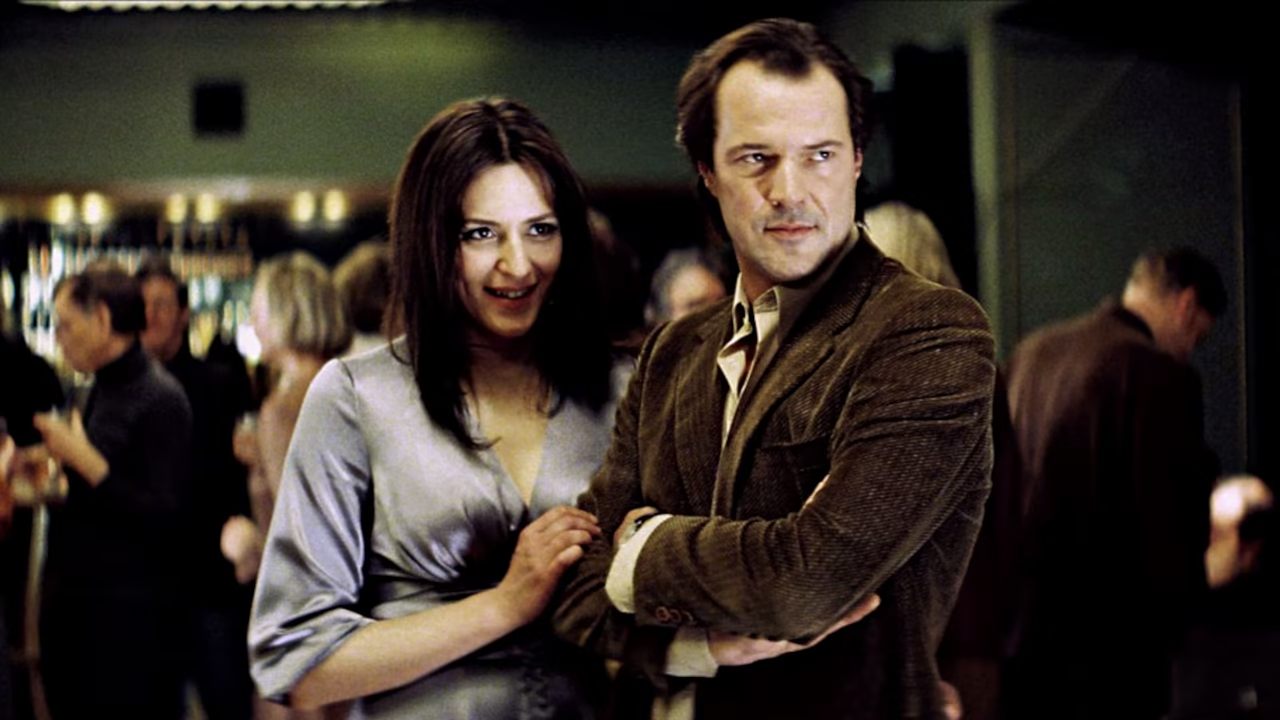
The order comes directly from the Minister Bruno Hempf (Thomas Thieme), who suspects something isn’t right about him. Dreyman is a writer who works for the state, and his job is to put an intellectual, loyal face on the regime’s narrative. The problem is that Dreyman is the kind of writer who actually means what he writes. He’s honest, and that honesty is starting to look like a liability to the Minister. So the Minister has sent the intelligence chief to have him watched.
That same evening at the theater, Minister Hempf is also in attendance. And here’s where things start to make sense. It turns out his real reason for being there is to watch Dreyman’s partner, a stage actress named Christa-Maria Sieland (Martina Gedeck). She has a reputation, well-earned, as one of the more celebrated theater performers of the time. What makes her accessible to the Minister is the fact that she works within the state-controlled arts apparatus. In East Germany, all major theaters were state institutions, and a career could be ended overnight by the right official. Hempf pulls the intelligence chief aside and makes sure he understands: the main job is watching Dreyman and his partner.
Surveillance Begins in Earnest
The Minister’s interest in Christa clearly has nothing to do with love. It’s about power, about reaching for something he has no right to touch. That becomes obvious at a party not long after. Dreyman and Christa are dancing when Hempf, apparently unable to stand watching it, steps up to the stage, stops the music, and gives a little speech thanking Dreyman for his service to the state and praising Christa for her strength in entertaining audiences night after night. Then he comes down from the stage, makes his way over to them, and uses the conversation as cover to press himself against her.
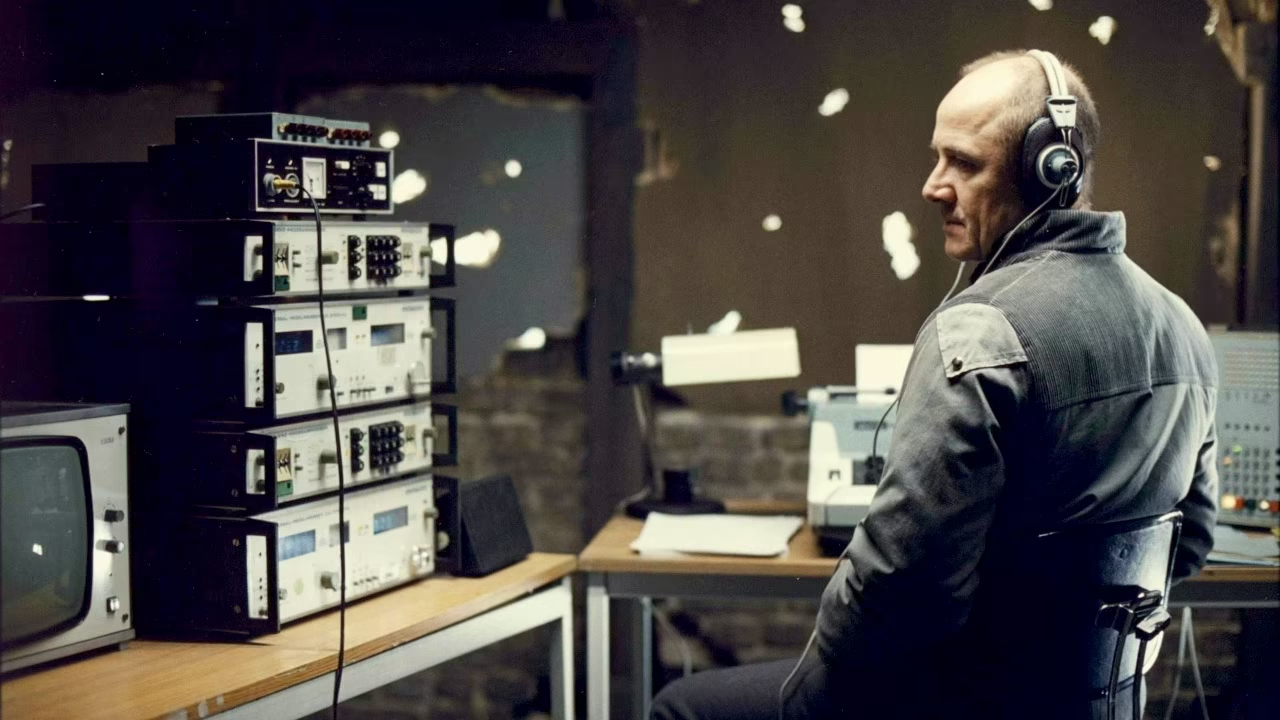
The next day, Wiesler begins his surveillance. Morning to night, he tracks when Dreyman leaves and when he comes back. Once he has a window, he moves his team into the apartment and plants listening devices everywhere, under the desk, in the ceiling, behind the light switch. Every word will be heard. Every sound will be recorded. He sets up his post in an empty attic not far from the building. Headphones on, typewriter ready, he logs everything for the intelligence chief.
At first it’s just a job, and Wiesler runs it by the book: flag anything that might threaten the state, report it immediately. But days go by and he finds nothing incriminating. What he finds instead is something unexpected, a couple living as two people who love each other, struggle together, and even bumble through the awkward moments. Dreyman’s sincerity. Genuine laughter. Intellectual arguments. A love that feels real. Wiesler starts to feel something like sympathy. Days of listening have turned a cold, methodical agent into someone who finds himself genuinely moved by the lives he was sent to monitor. What is there to suspect about a man this honest?
With nothing to report, the Minister looks for another angle. The one vulnerability he can find is that Christa takes sedatives to manage her anxiety. He has the intelligence chief bring her in. In the interrogation room, she’s threatened with losing her position as a theater actress, and not just her but Dreyman too, for allowing it. The chief makes clear this comes from the Minister himself. If she wants an exception, she can go ask him for one in person. Christa leaves without giving an answer, her status left deliberately in the air.
A few days later, walking home from rehearsal, she notices the Minister’s car trailing her. He offers her a ride. She ignores it. He tells her what happens to actresses who refuse. She gets in. He takes what he wants in the back of the car while his driver watches from the front seat. Wiesler is in his surveillance post when the Minister’s car pulls up outside Dreyman’s building with Christa inside. Something in him decides to help. He rings the apartment buzzer so Dreyman will come to the door and see what’s happening.
Afterward, Christa’s face is blank, hollow with self-disgust. Dreyman doesn’t say anything. He sits down at the piano and plays, like he needs to wait for the noise in his head to settle. When it does, he goes to the bedroom to talk to her. He barely gets a word out before she asks him to hold her. That night, Dreyman chooses silence over confrontation. He chooses to keep loving her, to push the questions away, to believe that nothing terrible happened in that car.
Dreyman Decides to Act
Explore More:
A week passes. He’s doing better, but the warmth between them is gone. He hasn’t touched her, hasn’t kissed her. Wiesler watches all of this and feels the weight of what he’s participating in. He’s starting to understand that this assignment is a betrayal. Then one night, Christa tells Dreyman she’s going out to see an old friend. Dreyman, quietly, asks her not to go. He tells her he knows what happened. He tries to make her see what she’s worth, that she’s a genuinely great actress, that she can build a career on talent alone, that she doesn’t need to take any other road.
On the other side of the wall, Wiesler is listening. He is completely absorbed when a colleague arrives to take over his shift, and he heads out to a nearby cafe to rest. A few minutes later, Christa walks in. Wiesler knows immediately she is not on her way home. She is on her way to meet Hempf. He approaches her, introducing himself as a fan, telling her how remarkable she is, how the sincerity she brings to her performances is something rare. He is trying to do for her what Dreyman tried to do, remind her of her own value, give her a reason to turn back. She doesn’t react. She walks away.
The next morning when Wiesler arrives for his shift, he reads his colleague’s overnight report. He is relieved. The report shows that Christa started to leave but came back within ten minutes, walked straight to Dreyman, and kissed him. The night ended well. Then, one morning, Dreyman is at a funeral. A close friend, a theater director named Albert Jerska, has died by suicide after years of professional ruin. Jerska had been blacklisted by the state, removed from all official employment rosters. In a fully state-controlled arts sector, that meant the end of a career with no private alternative to fall back on. His work was quietly strangled until there was nothing left of it.
Standing there with other writers, Dreyman begins to feel that something is deeply wrong. The group quietly decides to do something about it. They are going to write a piece about the rate of suicide in East Germany, the numbers the state stopped publishing in 1977. From that year onward, even medical specialists inside the country could no longer access the data, because it had been reclassified as a state secret. What was being hidden was significant. East Germany was recording between five and six thousand suicides every year, a rate consistently around fifty percent higher than in West Germany.
They know state television will never run it, so they will smuggle it to Der Spiegel, a weekly news magazine published in Hamburg that West Germans turned to when they wanted to know what the government didn’t want them to know. If they are caught, it means prison at best. At worst, they disappear. A contact smuggles in a typewriter from the West, a Groma Kolibri, small enough to hide under a cake. They need it because every typewriter registered in East Germany could be traced back to its owner by the unique imprint it left on the page. A machine with no registration record leaves no trail.
Wiesler Becomes the Protector
Dreyman starts writing in secret. His wife doesn’t know. He only works when she’s out. But Wiesler hears every keystroke from his post. He knows what Dreyman is doing. And he never reports it. Instead, he starts protecting him, writing reports that have nothing to do with what he actually heard, inventing just enough normalcy to keep suspicion away. When the intelligence chief gets a feeling that something illegal is in motion, Wiesler tells him there’s nothing going on. The state’s best interrogator is now actively lying to protect the truth.
For a while, everything holds. Then one day Dreyman is hiding the typewriter under the floorboards and Christa comes home early and sees him. She looks away and says nothing. The article gets out. It lands in West Germany, and it shakes things up. The intelligence chief launches an investigation and calls in a typewriter specialist to identify whose machine produced the document. He’s convinced it was Dreyman. But the specialist says the typeface doesn’t match Dreyman’s regular machine.
Running out of options, the chief brings Christa back in. He threatens to end her career completely, blacklist her from every company, close every door. And then, strangely, Christa asks if there’s anything she can do to protect herself. The chief smiles and asks her, simply, whether Dreyman wrote the article. She confirms it immediately, without thinking.
She says she doesn’t know where he hid the typewriter. They search the apartment. They find nothing. No evidence, no machine. But the chief isn’t done. He calls in Wiesler, the best in the business, and tells him to interrogate Christa until she gives up the location. If he fails, he’s fired. With no way out, Wiesler uses every skill he has. Under that pressure, Christa breaks and tells him where it is, thinking only of herself As she’s being walked out, the chief hands her a small gift: sedatives.
Wiesler’s Final Move
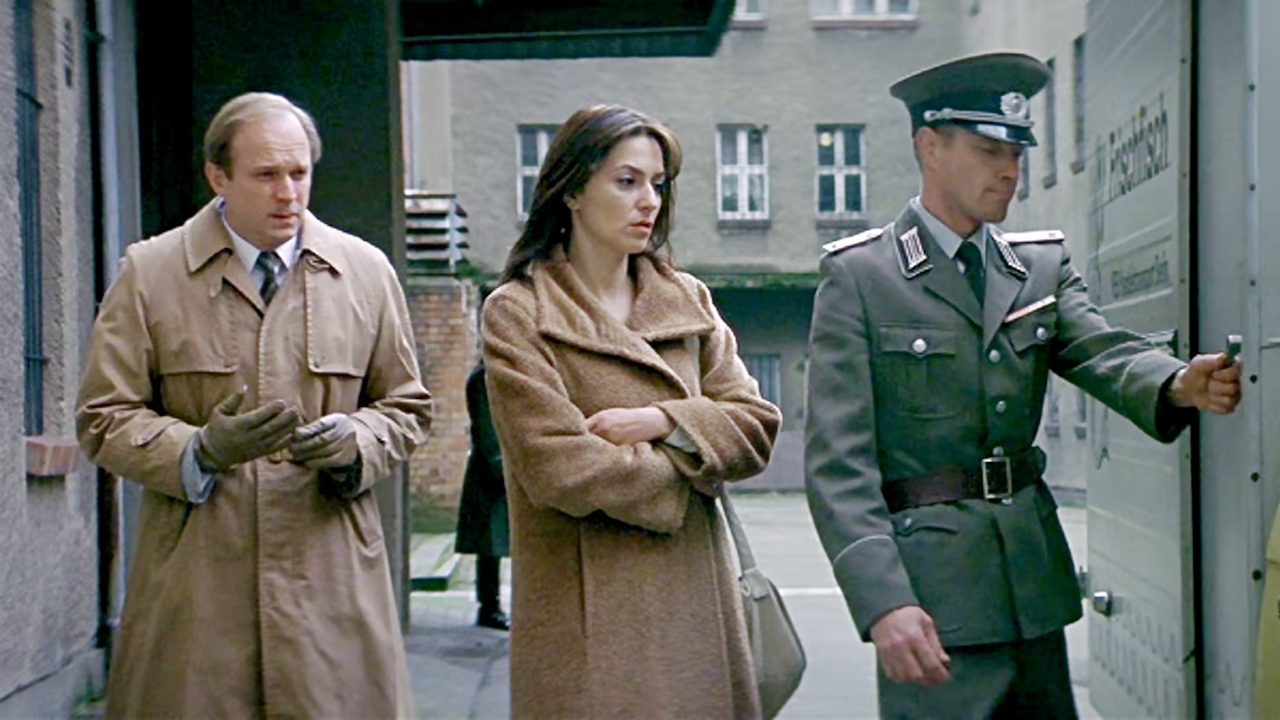
Then the chief calls for Wiesler, but Wiesler is already gone. He left the moment the interrogation ended, moving faster than the rest of them, racing to pull the typewriter from its hiding place before anyone else gets there. Christa comes home and goes straight to the shower. The search team arrives not long after. The chief goes directly to the floorboards. The machine is gone. Dreyman looks at Christa. He doesn’t need her to say anything. He knows. And Christa, buried in shame, unable to face Dreyman or herself, walks out of the apartment and steps in front of a moving car. She dies.
Two years pass. Dreyman runs into Minister Hempf, now retired and living comfortably. Dreyman asks him point-blank why he was never surveilled like the other writers. The Minister gives him a thin smile and says that if he wanted to, he could still hear everything that happens in Dreyman’s home. The meaning is clear. He stopped listening because Christa is gone, and without her, there was nothing worth hearing anymore. Dreyman walks away holding the rage inside him.
He goes home, finds the listening devices scattered throughout the apartment, and then goes to the national archive that stores all the surveillance transcripts. He reads through the pages. The reports don’t match what actually happened. Whoever wrote them was protecting him, steering the record away from the truth. He can feel it. During the period when he was writing in secret, someone was covering for him completely. The officer’s codename in the files is HGW XX/7.
Dreyman checks the typewriter, there is a small thumbprint in red ink on the ribbon cover, left by the Kolibri’s red ribbon, the only kind it used. That is how he knows for certain it was Wiesler. He asks for the file on HGW XX/7. The clerk tells him the officer was dismissed two years ago. He is working as a postman now. Dreyman finds him, watches him from a distance, not to confront him, just to finally put a face to the man who saved his life.
Two more years go by. Wiesler is walking past a bookshop and stops at the window display. Dreyman’s new novel, Sonate vom Guten Menschen, Sonata for a Good Man. The same title as the piece Jerska gave Dreyman years ago. Wiesler goes inside and picks it up. He opens it to the dedication page: To HGW XX/7, in gratitude. The clerk asks if he wants it giftwrapped. He says no. It is for him. And that is where the film ends.