Wes Anderson built The Grand Budapest Hotel around a simple, melancholy premise: a man who became extraordinarily wealthy and lost everything that mattered anyway. The film, released in 2014 and shot partly inside an abandoned department store in Gorlitz, Germany, follows a concierge named Monsieur Gustave H and a lobby boy named Zero across a fictionalized Central Europe on the brink of war. It won four Academy Awards, but the statues were almost beside the point. What people remembered was the grief underneath the pink frosting.
The story reaches the audience in layers—a writer, an old man, a hotel that should have been sold off years ago but wasn’t. Over a single dinner, Zero Moustafa begins to talk, and what comes out is a murder, a stolen painting worth more than everything else in the estate combined, a prison break engineered through pastry boxes, and a chase across a snowy mountain that ends badly for more than one person. All of it spirals back, eventually, to a woman named Agatha and why a very rich man keeps returning to a small corner room at the top of a hotel nobody else visits anymore.
A Writer Inherits a Story
The film opens with a young girl walking through the cemetery of Old Lutz, hanging a keychain on the statue of a writer whose name is never mentioned. The Author (Tom Wilkinson) was a famous novelist, one of whose masterpieces was a novel called The Grand Budapest Hotel. The scene cuts back to 1985, when the Author was still alive and working as a professor, reflecting on the process of writing that very novel.
Decades earlier, the young Author (Jude Law) took a vacation to a mountain resort in the Kubrovka region and checked into the Grand Budapest. In its heyday the place had been genuinely world-class, but by the time the Author stayed there it was practically a ghost town, with some of the older wings already torn down. The hotel seemed to carry the weight of everything the country had lost in the decades since its glory days.
With the hotel so empty, the Author spent a lot of time chatting with a lobby boy and receptionist named Jean (Jason Schwartzman). One evening he noticed an elderly man sitting alone in the corner, and that man was Mr. Zero Moustafa (F. Murray Abraham), the owner of the Grand Budapest himself. At his peak, Moustafa had been the wealthiest man in the province of Kubrovka, yet whenever the off-season hit he still came back to stay at his own hotel, always in the same small corner room at the top.
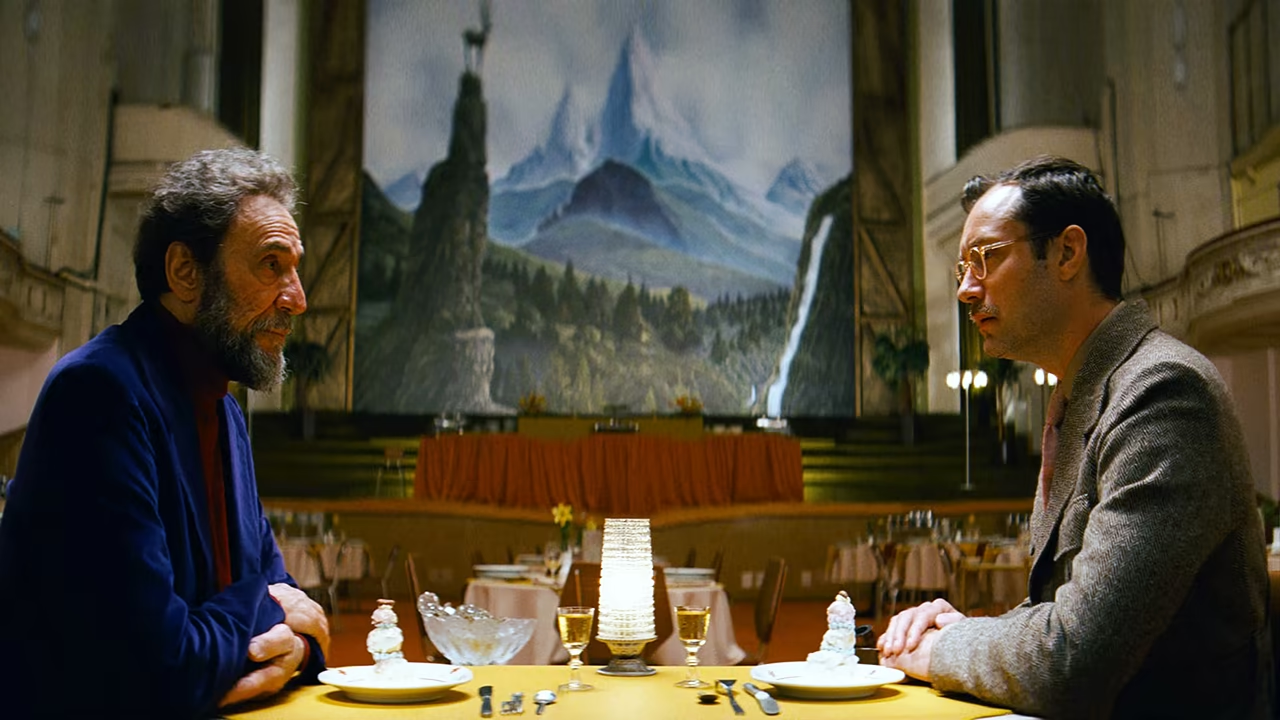
Later, while the Author was relaxing in his bath, Moustafa appeared and complimented his writing. One thing led to another, and Moustafa invited the Author to dinner to tell him how he’d come to own the hotel. The story began around 1932, with a hotel manager named Monsieur Gustave H (Ralph Fiennes), a man who ran the Grand Budapest with meticulous, hawk-eyed attention to service and detail. One of his longtime guests was Madame D (Tilda Swinton), an elderly woman he’d known for nineteen years, and with whom he’d maintained an unofficial, undefined relationship just as long.
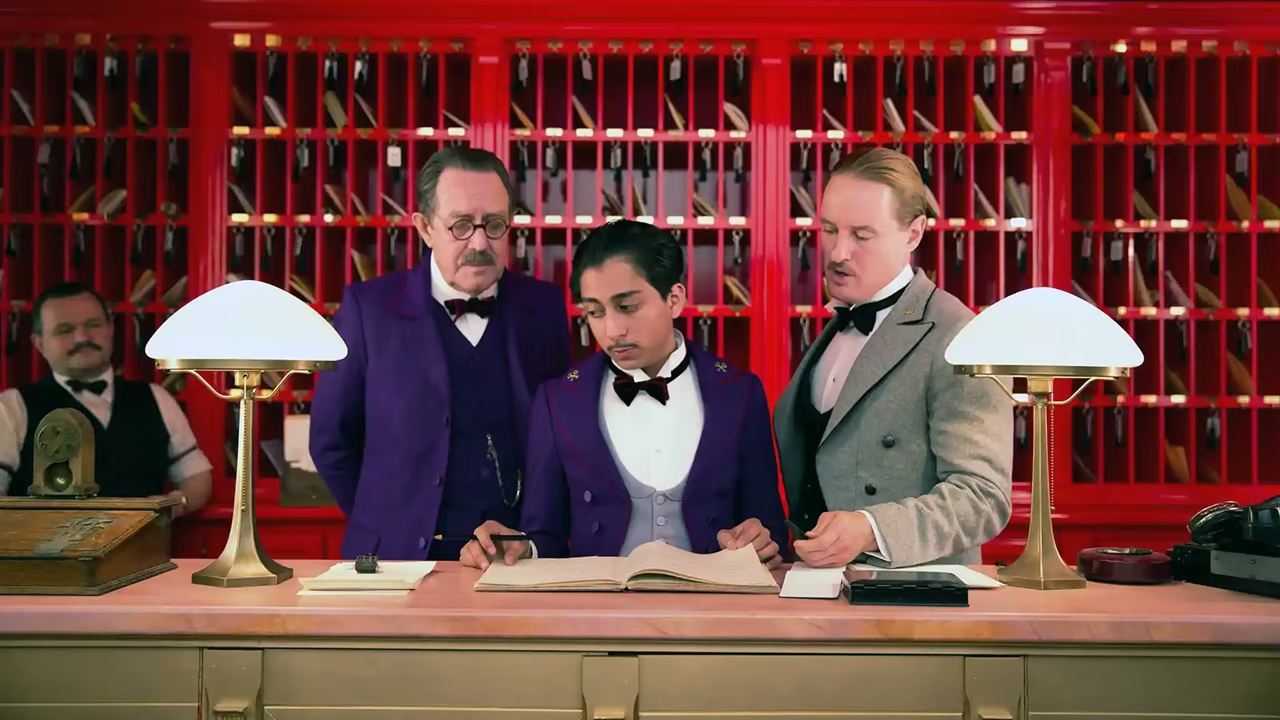
When she checked out after her latest stay, she told Gustave she was terrified it might be the last time they’d see each other and begged him to come home with her to the city of Lutz. He calmed her down, and she left, but not before asking him to light a candle for her at the Church of Santa Maria. As Gustave sent a lobby boy to do it, he realized he hadn’t properly met the new hire. The boy’s name was Zero (Tony Revolori). He was still in his probationary period, his education barely extending to reading and basic arithmetic, with no family to speak of.
Gustave took it upon himself to train Zero personally. For the entire first month, Zero followed him everywhere, watching as Gustave attended to every guest with meticulous care and charm, covering the full range of attention he was known for, including the more personal kind he extended to women of all ages and circumstances. Zero slept in a small corner room at the top of the hotel, the same corner room, and woke before dawn every morning. It was during this time that he also met Agatha (Saoirse Ronan), a baker’s apprentice who supplied pastries to the hotel, though when telling the story, Moustafa didn’t want to dwell on her too long.
Madame D’s Poisoned Inheritance
Almost two months into Zero’s apprenticeship, nobody at the hotel, not even Gustave, knew who actually owned the Grand Budapest. The only person who appeared on the owner’s behalf was a lawyer named Deputy Vilmos Kovacs (Jeff Goldblum), who came around occasionally to review the books. Then one morning, while Zero was picking up the papers, he spotted a headline that stopped him cold: Madame D was dead. Given his connection to her, Gustave decided to go to Lutz immediately and brought Zero along.
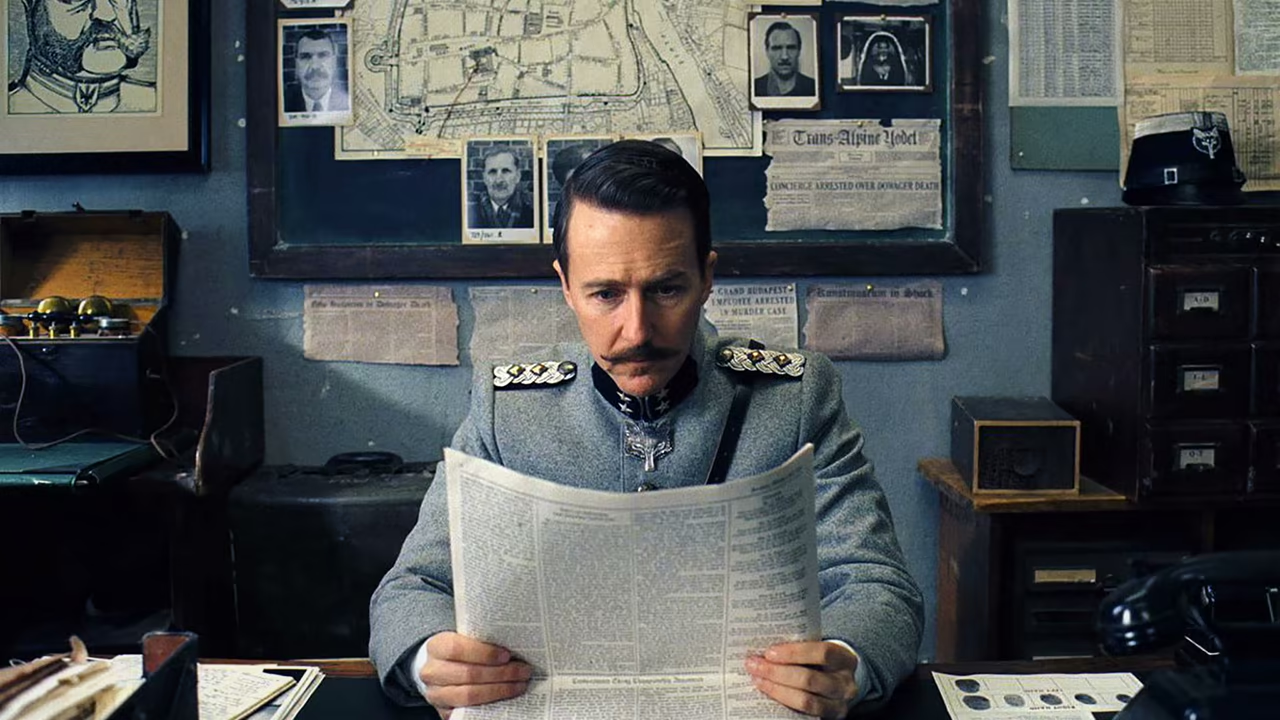
On the train, Gustave couldn’t stop talking, eaten up with guilt over not having gone with her when she asked. Then the train was stopped for a document check. Gustave’s papers were in order, but Zero’s were not. As an undocumented immigrant without the proper permits to cross the border, he was ordered off. Just as things were getting tense, the police commander arrived, a man named Albert Henckels (Edward Norton), who had stayed at the Grand Budapest as a child and remembered Gustave fondly. Zero was allowed to cross, the officers who’d caused trouble were made to apologize, and the two were given a document to show if stopped again.
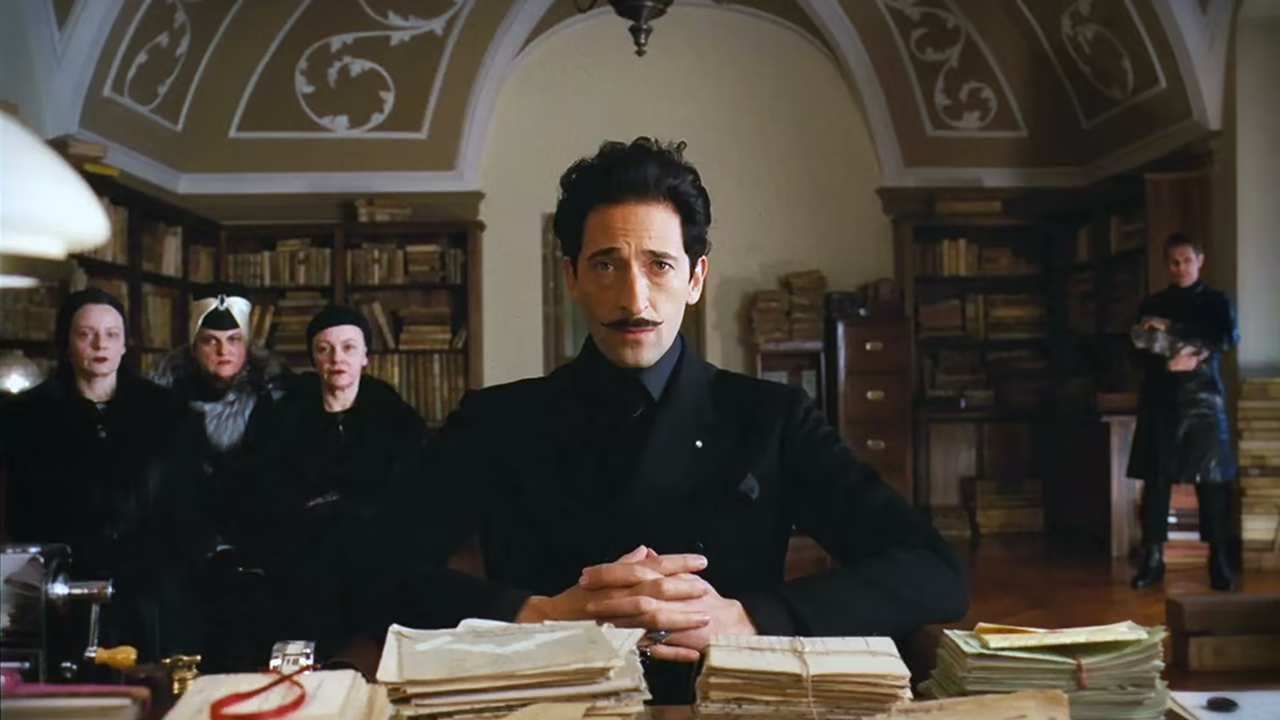
At Madame D’s estate, Gustave paid his respects. A servant named Clotilde (Lea Seydoux) quietly told him to go to the kitchen, because the head servant, Serge X (Mathieu Amalric), wanted a word. But before Serge could speak privately with Gustave, he followed him into a room where the entire family had gathered for the reading of the will. Deputy Kovacs handled the proceedings. The bulk of the estate would go to Madame D’s son Dmitri (Adrien Brody), her daughters would receive monthly allowances, and distant relatives modest gifts.
One significant exception stood out. Before her death, Madame D had sent Kovacs a letter specifying that a painting she owned, “Boy with Apple”, was to go to Gustave, completely tax-free. Dmitri was furious. He accused Gustave of being an intruder, a home-wrecker, a seducer of old women. Rather than escalate things, Gustave quietly retreated to the kitchen. There, Zero asked what “Boy with Apple” even was, and Gustave explained it was priceless, worth more than everything else in the estate combined.
When Zero said he was curious to see it, the two slipped into Madame D’s private chambers. After Gustave laid out just how valuable the painting was, Zero, with the most innocent expression imaginable, pushed a chair toward the wall. The message was clear. Since they were both thinking the same thing, Gustave lifted “Boy with Apple” off the wall and replaced it with a cheap substitute. The substitute painting, a garish nude, is “Two Peasants Fighting Over a Goose”, a joke that recurs later when Dmitri discovers the swap.
As they prepared to leave, Gustave asked Serge to wrap the painting. While doing so, Serge quietly slipped a sealed envelope marked “confidential” into the package. Gustave asked what Serge had wanted to tell him, and Serge said there wasn’t time and promised to write the next day. On the train back, Gustave couldn’t stop gushing over the painting, but he was also nervous, because Dmitri would come after them.
The plan was to sell it on the black market as soon as possible, then lay low until things cooled down. Zero would get 1.5% of the sale. Zero tried to negotiate up to 10%, but Gustave refused. But he made Zero a solemn promise: if Gustave died first, which was almost certain given the difference in their ages, Zero would inherit everything Gustave owned. With the painting, that stood to be considerable. On the spot, Gustave wrote out a will leaving all his worldly possessions to Zero.
Explore More:
Gustave Arrested, Plot Thickens
Back at the hotel, they locked “Boy with Apple” in the safe. Before they could exhale, police arrived, led by Henckels, to arrest Gustave on suspicion of murdering Madame D. She hadn’t died of natural causes but had been poisoned. Gustave tried to run. He didn’t get far. A week later, Zero visited Gustave in prison. The murder accusation had come from Dmitri’s family, and the police report named the one witness to Gustave’s presence at the estate before Madame D’s death, Serge, who had vanished without a trace the day after she died.
Dmitri had sent his enforcer, Jopling (Willem Dafoe), to track Serge down. Even Serge’s sister had no idea where her brother was. In prison, Gustave made himself useful in the kitchen. He was a genuinely talented cook, and the more dangerous inmates took a real liking to his food. He had Zero bring in pastries from Mendl’s, the bakery where Agatha worked, and shared them with a group of inmates led by a man called Ludwig (Harvey Keitel), eventually earning his way into their circle.
Ludwig and his crew had an escape plan and a detailed hand-drawn map of the prison, but no tools to break through the floors and walls. Since Gustave had been smuggling in pastries without raising suspicion, they recruited him to bring in what they needed. Zero asked Agatha to help by hiding chisels, hammers, and other equipment inside Mendl’s pastries shaped and decorated to look exactly like the real ones. The guards didn’t bat an eye, and the crew got to work.
Meanwhile, on the outside, Dmitri was pressuring Kovacs to transfer all of Madame D’s assets into his name. Kovacs refused, because there was still a missing document and the murder case was still open. On his way home, Kovacs was tailed by Jopling and killed. During this time, Zero had been sneaking into Agatha’s room at night, and after one of those visits he told her everything, including the stolen painting, the safe, the combination, and where the key was hidden, in case something happened to either of them.
The breakout unfolded at night. The group slipped out through the floor they’d broken through, nearly got caught by an inmate who started yelling for the guards until one of the tougher prisoners silenced him, and made their way down, losing one of their crew when they accidentally drew the attention of guards playing cards. Gustave and the survivors made it out through the drainage tunnel, where Zero was waiting.
Once they were clear, Gustave turned on Zero and unloaded on him, no change of clothes, no cologne, nothing prepared. He said some genuinely cutting things, that Zero came from a backward country, a poor country, and that he’d forgotten everything Gustave had taught him. He went silent only when Zero told him the truth, that he hadn’t come to this country looking for opportunity. He’d come because of war, and both of his parents had been killed in that war. Gustave went quiet, then apologized.
Serge Found, Then Silenced
Through his network of hotel manager contacts, a kind of mutual aid group called the Society of the Crossed Keys where word passed from manager to manager, Gustave arranged a pickup. The manager who came had news: he’d located Serge, hiding on a remote hilltop in the Gabelmeister region, and Serge had agreed to meet Gustave at a church.
Back at Madame D’s estate, Dmitri had gone through the inheritance paperwork and realized the painting was gone. The servant Clotilde gave him up. Elsewhere, Henckels received a report that a woman had been found with her throat cut, and that woman was Serge’s sister. She’d received a message from Serge telling her to flee to his hiding spot, but Jopling had gotten there first. Zero sent a telegram to Agatha: get the painting from the safe and meet them at the agreed point.
At the church, they found Serge hiding in a confessional. He explained that he’d fled because his life was in danger, and that Madame D had written a second will, one valid only in the event of her murder, that Dmitri had destroyed. But Serge had made a copy. Before he could say what was in it, Jopling killed him, right there in the booth.
Zero and Gustave gave chase. A wild pursuit on snow sleds ended when they crashed at the edge of a cliff, with Gustave dangling over the side and Zero face-first in the snow. Jopling moved toward Gustave, stomping the ice to make him fall. Zero came to just in time and shoved Jopling off the cliff. Gustave was safe. Henckels, watching from a distance, called for Gustave to turn himself in. Gustave wasn’t about to do that. He and Zero took Jopling’s motorcycle and headed straight back to the hotel.
By the time they arrived, the Grand Budapest was crawling with police and soldiers, as the hotel had been turned into a temporary military base while war was breaking out. In the middle of it all, Agatha arrived with stacks of pastry boxes, there to retrieve the painting from the safe, while Gustave and Zero waited outside, disguised as delivery boys. Then a car pulled up: Dmitri. Agatha had already retrieved the painting, but as she walked out she came face to face with him. She tried to slip away, but he’d already clocked her and followed her into an elevator, quietly tearing away a corner of the wrapping to find “Boy with Apple”.
Gustave and Zero rushed inside, got past the guards with a box of Mendl’s pastries, and reached the elevator just as Agatha slipped out with Dmitri close behind. She ran, and he lost her in the crowd. Gustave and Zero found Dmitri. The moment he saw Gustave, Dmitri drew his gun and fired. They ducked. With the tension of the war already in the air, the police and soldiers in the building began shooting at each other out of paranoia, with everyone suspecting everyone else of being a spy. Henckels had to arrive in person to stop it.
With the commander present, Dmitri announced that he had Gustave surrounded. Gustave shot back that Dmitri was responsible for the deaths of Kovacs, Serge, and Serge’s sister. Henckels ordered them both arrested. Then a woman screamed, because Agatha had slipped while hiding from Dmitri and was hanging from a window ledge. Zero bolted to help her and ended up hanging from the ledge alongside her. Somehow, they both survived the fall, landing on top of Agatha’s pastry delivery van.
The Second Will Revealed
Once everyone was safe, Henckels examined the painting and the letter Serge had tucked inside the wrapping. The letter, valid only in the event of Madame D’s murder, laid out its contents clearly: she left everything to Gustave. Everything, including ownership of the Grand Budapest, which had been hers all along. On top of that, textile factories, weapons factories, and farmland.
Overnight, Gustave became the wealthiest man in the province. Dmitri, stripped of his entire inheritance, disappeared without a trace. With the crisis resolved and Gustave newly, absurdly rich, Zero was promoted to hotel manager and ran the place exactly as Gustave had taught him, with the same obsessive discipline and commitment to service. Zero and Agatha were married, with Gustave as their witness.
A year later, the three of them were traveling to Lutz together when their train was stopped for a document check. Just as before, Gustave and Agatha were fine, but Zero was still an undocumented immigrant, still without official papers, and with the war on, that hadn’t gotten any easier. When Zero was ordered off the train, Gustave stepped up and produced the note Henckels had given them. This time it was no longer valid. Gustave refused to back down, and for that, he was shot and killed on the spot.
After Gustave’s death, Zero inherited everything and became the wealthiest man in the country. But two years after marrying Agatha, she contracted a mysterious fever and died, along with their unborn child. Having told all of this to the Author over dinner, Mr. Zero Moustafa finally explained why he’d held onto the hotel all those years, even as it emptied out and fell apart around him: it was where all his memories of Agatha lived. Shortly after, he gave up ownership of the Grand Budapest and turned it over to the state.